


By Jorge Casuso
October 2, 2026 – Santa Monica's economic decline over the past decade and its media portrayal as a "troubled" city reflects both unique problems and regional trends, according to a RAND Corporation study released Thursday.
The 63-page report, titled "Santa Monica's Recent Economic and Social Trends: A Case Study with Regional Comparisons," is based on data analysis of Santa Monica and "multiple comparison cities in the Los Angeles metro area," as well as 14 expert interviews.
The study concludes that Santa Monica’s economic downturn "has been larger than peer cities," with aspects of its economy declining more than Beverly Hills, Culver City and West Hollywood.
"We find that concerns about tourism, retail sales, and other business indicators are warranted, with the city performing worse than most peers we consider," the report stated. "But other common beliefs, such as those around worsening homelessness and crime, are only partly supported by the data."
Some of the negative trends also "may involve changes in macroeconomic conditions, commuting preferences and other factors that are beyond the city's direct control," a conclusion based on interviews with officials in other local city governments.
Santa Monica experienced a "large downturn in sales across most retail sectors" that began around the coronavirus shutdown that never fully recovered and "resumed a negative trend shortly afterwards that is ongoing."
Between 2015 and 2025, sales of clothing and accessories were down 75 percent and food services down 24 percent. The trends reflect reduced visitor counts that are 58 percent of the "pre-pandemic peak" and "persistently high vacancy levels" on the Promenade and at Santa Monica Place.
While the City's past “extractive mindset” that made it difficult to open businesses has "changed meaningfully" in recent years, "interviewees from both the public and private sectors pointed to a number of current headwinds for economic growth in the city."
These included new labor laws adopted by the City Council that focus "on mandatory rehiring requirements and labor peace agreements for lessees of city-owned commercial properties" and taxes on sales, parking and hotel occupancy" that are "the highest city tax rates among many tourism-oriented cities in Southern California."
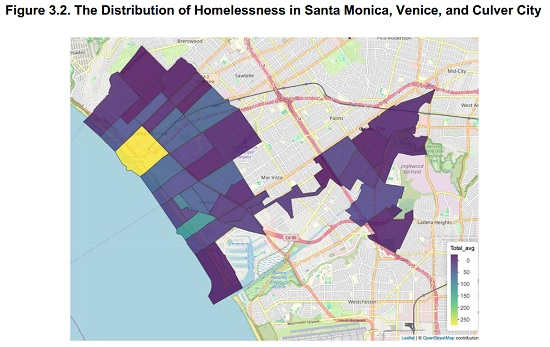 |
Meanwhile Santa Monica's homeless population "has remained stable" but "is highly concentrated downtown and along the beachfront, where it is most visible to businesses and visitors." Of the comparison areas examined only Venice had similar levels.
"Santa Monica business owners pointed to the role of unsheltered individuals with significant mental health problems or untreated substance use disorders in making it difficult to attract and retain customers to businesses due to concerns about crime and disorder," the report said.
Crime, like homelessness has remained stable in most of Santa Monica, although aggravated assault and robbery, which peaked in 2018, "remain elevated" and are "overwhelmingly a downtown phenomenon."
"Half of aggravated assaults and 71 percent of robberies occur in the 5 percent of the city’s area with the most crime, which is overwhelmingly downtown," the report noted. Venice had similar increases in "serious violence."
When it comes to housing development from 2018 to 2025, Santa Monica had the lowest level of housing production per resident of any comparison city except Beverly Hills, the study found.
On average, "it takes over 6 years for a housing project to be built and ready for occupancy in Santa Monica, with the majority of this time preceding the issuance of a building permit."
Housing production is "poised to temporarily increase due to the city's 2022 exposure to the state 'builder's remedy' policy, which allowed a slate of apartment buildings representing thousands of new units to be approved during a window when the city’s land use and zoning regulations were effectively suspended."
Recent "substantial" reforms have "dramatically improved" the City's entitlement process, "with one land-use attorney stating they would 'rather propose a housing project in Santa Monica than literally any other jurisdiction in the entire state.'" However, the reforms "have not yet translated into an increase in new unit construction," the report concluded.
The report notes that the City's new leadership "has recently undertaken substantial policy reforms that may improve the city’s economic trajectory."
They include changes to the city's homelessness services such as "relocating key homelessness services out of downtown which may contribute to reducing the concentration of homelessness."
There have also been several recent changes to Santa Monica’s policing, "including achieving full staffing for the first time in 20 years, a new downtown substation, increased foot and bike patrols, and greater coordination with city attorneys to increase prosecution rates."
However, "the impacts of these changes on public safety remain unclear," the report said.
For the full report click HERE